




Newsletter Subscribe
Enter your email address below and subscribe to our newsletter

Rising Above the Noise

 Byocta
City builders rarely struggle with production chains. Economic simulations rarely struggle with numbers. Political simulations rarely struggle with ambition. The challenge emerges when a game attempts all three simultaneously. Rise of the Merchants enters this crowded territory with a proposition built around trade, governance, social influence, and city development within a persistent online medieval world. According to the developers, players begin with a modest settlement and gradually transform it into a politically significant trading center while navigating economics, diplomacy, elections, and broader regional competition.
Planned Release Date: 29 Oct, 2026
Rise of the Merchants distinguishes itself through a progression structure that is far more guided than many management simulations. Rather than leaving players entirely to their own devices, the game places significant emphasis on economic quests that continually provide new objectives and challenges. These quests do more than introduce mechanics.
They create momentum, encouraging players to expand production, establish trade routes, acquire resources, and pursue increasingly ambitious commercial goals. As a result, progression feels purposeful rather than self directed, with each objective acting as another step on the road toward becoming a wealthy and influential merchant.
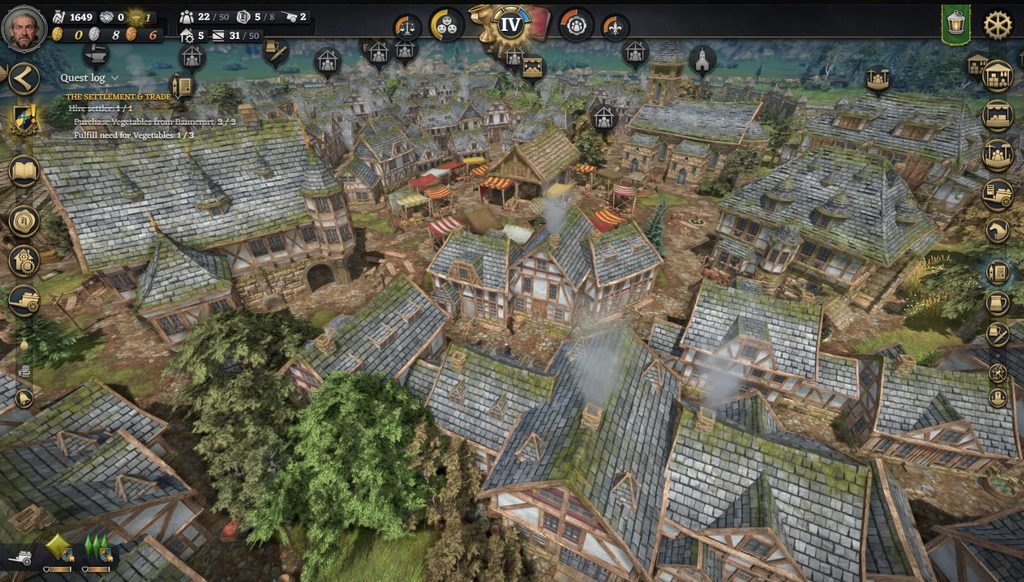
Supporting this progression are periodic events and personal decisions that place the player within the world rather than above it. Throughout the journey, players are presented with choices that help reinforce the role of an ambitious merchant attempting to climb the economic ladder.
These moments provide welcome breaks from day to day management and add personality to what could otherwise become a purely systems driven experience. While their long term impact is difficult to fully assess at this stage, they succeed in giving context to the player’s growth and contribute to the broader narrative of commercial success.
Where Rise of the Merchants becomes most engaging, however, is in the way its various systems begin interacting with one another as settlements expand. What starts as relatively straightforward resource management gradually evolves into a balancing act involving production chains, trade routes, worker assignments, quest requirements, and expansion planning.

Every successful development tends to create new demands elsewhere. Increased production requires additional transportation capacity. New trade opportunities introduce fresh logistical considerations. Quest objectives place additional pressure on existing infrastructure. The result is a management experience built around prioritization rather than simple optimization.

What makes the experience compelling in its current state is how effectively these systems support one another. The quest structure provides direction, trade and logistics create meaningful challenges, and character events help reinforce the player’s role within the world. Together they form a management framework that consistently encourages growth without allowing progression to feel aimless. At the same time, many of the questions that ultimately determine the quality of a simulation of this scale remain unanswered.
Large management games frequently reveal both their greatest strengths and their most significant weaknesses only after dozens of hours, when logistical networks become increasingly complex and the pressure on underlying systems begins to mount. For now, the foundation appears promising, but whether it remains compelling under those conditions is something only extended play can determine.

The Economic Genre’s Constant Challenge
Merchant simulations live or die according to the quality of their economic systems. The genre frequently struggles with two opposing problems.
The first is oversimplification. Games that automate too much risk becoming passive exercises that offer little meaningful decision making.
The second is excessive complexity. Titles that inundate players with endless production calculations can create depth at the expense of accessibility.
The success of Rise of the Merchants therefore depends on how effectively it balances strategic depth with readability. An economic simulation should encourage analysis without forcing players to wrestle constantly with obscure systems or unintuitive interfaces.
This balance will ultimately determine whether the game appeals only to genre enthusiasts or reaches a broader management simulation audience.

The Importance of Progression and Agency
Management games derive much of their strength from the player’s perception of influence. A successful trade network should feel like the direct result of informed decisions rather than predetermined growth.
Meaningful progression requires more than increasing numerical values. New businesses, advanced production chains, regional expansion, and strategic specialization must introduce genuinely new considerations rather than merely scaling existing tasks.
If each stage of development unlocks additional strategic possibilities, the journey from local merchant to commercial magnate gains a sense of purpose beyond simple accumulation.