


Newsletter Subscribe
Enter your email address below and subscribe to our newsletter

Rising Above the Noise
 Byocta
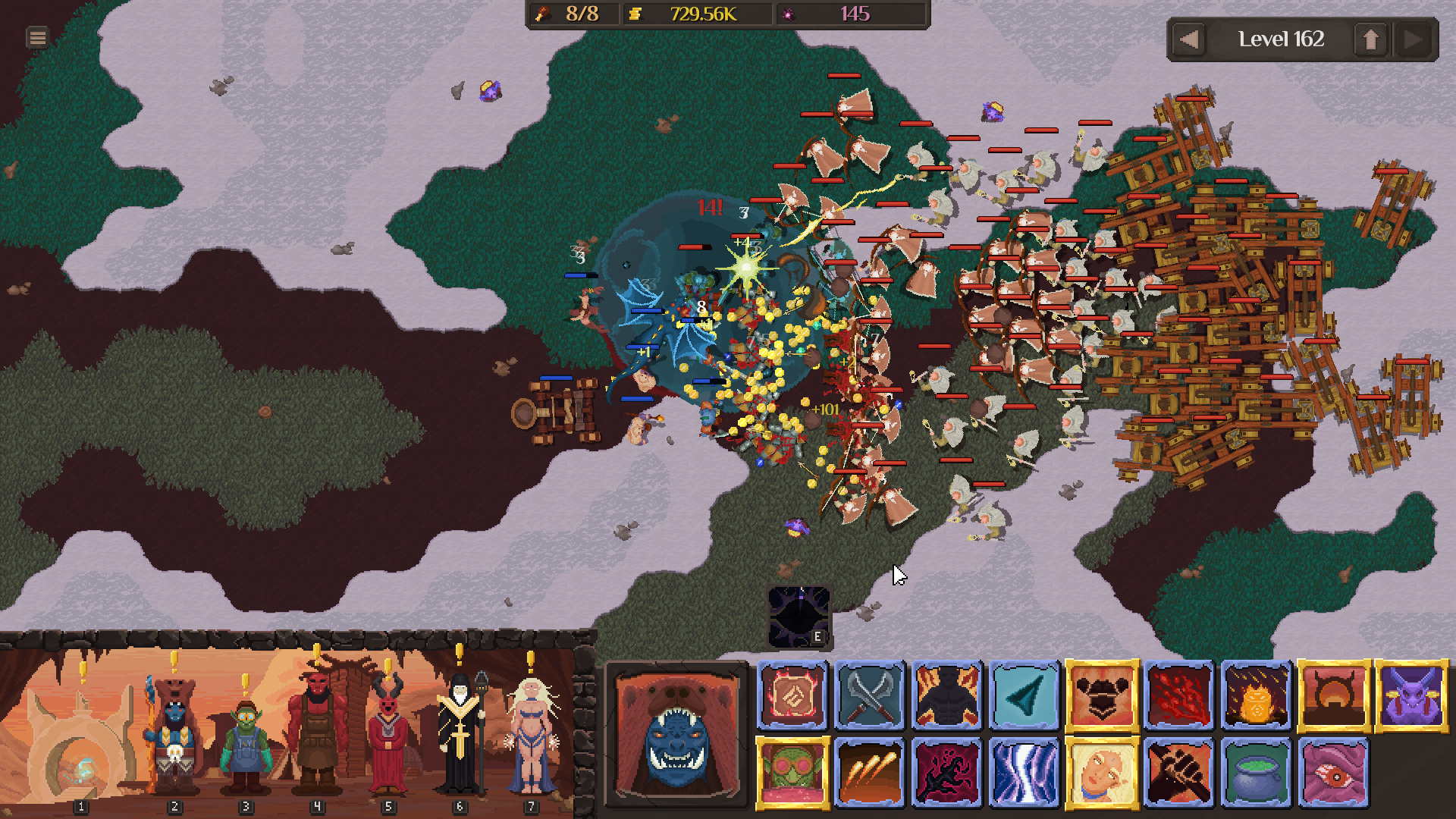
Orc Incremental, developed by Nice Ride and published by Playsaurus, enters the incremental strategy space with a structural proposition that is unusually rigorous. The genre has long suffered from a mechanical asymmetry in which exponential numerical scaling overwhelms player agency, reducing late game interaction to passive observation. Orc Incremental attempts to resolve this tension by embedding spatial constraints, tactical interventions, and prestige based mathematical modulation into a single coherent engine. Scheduled for release on September 8, 2026, the title warrants close examination for how it integrates spatial auto battling with multiplicative progression loops.

The game’s core progression chain can be expressed as a four stage geometric pipeline. A solitary Orc grunt initiates the run. Card drafting and totem placement introduce spatial radii and positional synergies. Tactical encounter walls impose discrete breakpoints that require active spell casting. Dark Rebirth ascension resets the run while enabling Chieftain selection and multiplicative modifiers. Each stage is structurally distinct, yet each is mathematically interdependent.
The most significant innovation lies in the grid formation engine. Traditional clicker titles treat combat as an abstract numerical comparison. Orc Incremental instead forces the player to manage positional geometry. Totemic anchors project localized buff fields. These radii are not cosmetic. They are strict spatial constraints that filter viable unit arrangements. The player must organize drafted unit cards around these anchors to maximize area effect coverage. The grid becomes a mathematical surface in which adjacency, clustering, and radial overlap determine the viability of higher tier pushes.
Active interventions reinforce this spatial discipline. Real time spell casting allows the player to breach encounter walls that would otherwise halt automated progression. These walls function as tactical gates. They convert the run from a purely passive exponential curve into a hybrid system in which manual input can temporarily reshape the deterministic flow. The drafting system introduces volatility. Each push requires balancing front line durability against siege capability. The player cannot rely on a universal layout. The spatial configuration must be continuously reoptimized.
The prestige loop, termed Dark Rebirth, serves as the economic engine. Rather than providing flat numerical boosts, each reset alters the baseline parameters of future attempts. Chieftain selection introduces distinct mechanical modifiers that redefine resource generation and unit synergy. This design choice mitigates the monotony that often characterizes early game resets in incremental titles. Each ascension becomes an exploration of a different mathematical build rather than a repetition of the same curve. Offline progression ensures that the economic layer continues to accumulate during downtime, allowing immediate reinvestment into new trial milestones.
The strategic verdict is clear. Orc Incremental demonstrates a refined understanding of systemic strategy. By combining tactile card drafting, active spell interventions, spatial grid organization, and deep prestige scaling, the title rewards methodical planning as much as raw patience. Nice Ride and Playsaurus have constructed a system that treats geometry as a progression filter and determinism as a design tool. Orc Incremental stands out as a high priority title for players who value mathematical optimization and structural clarity when it arrives on Steam this September.


The Incremental Genre: Origins, Structure, and Contemporary Proliferation – Octavius Reviews
Within the broader incremental and idle genre, Orc Incremental occupies a distinct niche by straddling the line between passive clickers like Cookie Clicker and active tactical auto battlers like Despot’s Game or The Tower.
The game is scheduled for release on September 8, 2026. However, based on developer lineage, mechanic design, and early demo engagement, here is how it ranks conceptually and structurally within its genre:
Personally, and we aren’t supposed to get personal…I think this type of game gets boring after some time. That is probably just me. So, buy it when it is on sale?
Why we gave it 3 Thumbs?
Reasoning: To claim that Orc Incremental is attempting to reinvent the incremental genre would be an exaggeration. Rather than a total structural revolution, the title represents a refined synthesis of existing systems.
Instead of dismantling the genre, Nice Ride and Playsaurus are executing a clever convergence of two established subgenres: the mathematical prestige clicker and the tactical grid auto battler. So…
Rating 3 out of 5 Thumbs: 👍 👍👍 (Inside the genre a fair assesment)
[Pure Idlers]                    [Tactical Auto Battlers]
(Cookie Clicker)                   (Despot's Game)
       │                                  │
       └──────────► [Orc Incremental] ◄───┘
               (Incremental Auto Battler)
| Feature Dimension | Standard Incremental Games | Tactical Auto Battlers | Orc Incremental |
| Primary Growth Loop | Exponential Menu Math | In-Run Gear/Stats | Dual Grid Synergy + Multiplicative Prestige |
| Fail State / Reset | Optional Soft Reset | Permadeath / Run Wipe | Structural Ascension (Dark Rebirth) |
| Player Agency | Low (Clicker / Upgrades) | High (Positioning / Micro) | Medium-High (Tactical Drafting + Active Spells) |
| Spatial Utility | None (UI-driven) | High (Grid combat) | High (Totemic radii and unit formations) |