


Newsletter Subscribe
Enter your email address below and subscribe to our newsletter

Rising Above the Noise

 Byocta
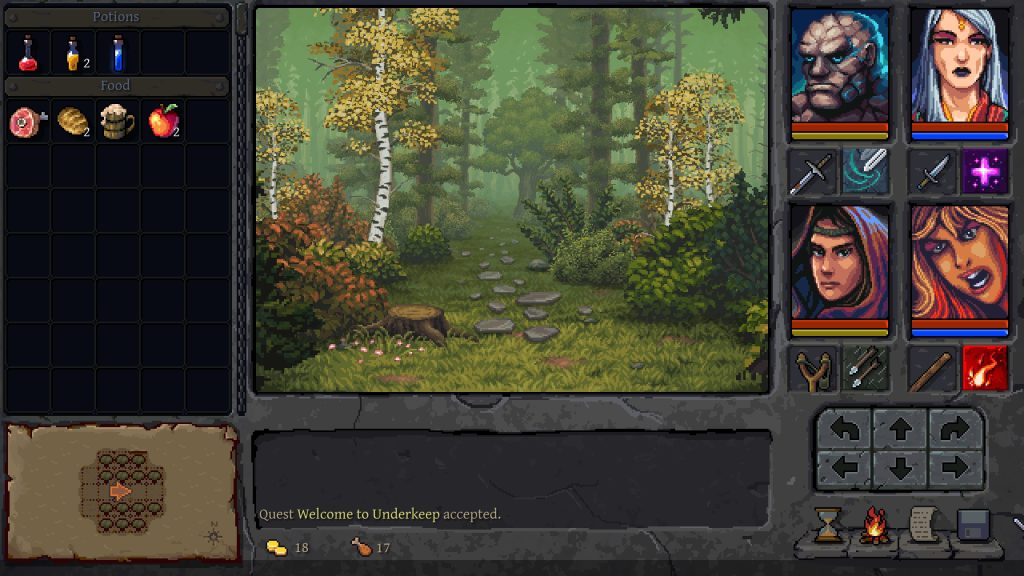
Underkeep is an old school style role playing dungeon crawler that modernizes grid based movement while keeping the core mechanical complexity intact. The game puts players in command of a four person party, forcing strategic position management and resource allocation across handcrafted subterranean tiles. Every step demands deliberate planning as players navigate labyrinthine levels, disarm environmental hazards, and engage in tactical turn based combat reminiscent of classic 90s dungeon crawlers.
RELEASE DATE: 5 Nov, 2026
The central challenge in evaluating Underkeep is not determining whether it succeeds as a retro dungeon crawler. It clearly does. The more difficult task is separating what the game is trying to achieve from my own preferences regarding game design. That distinction matters because Underkeep is not chasing contemporary role playing trends, nor does it seem interested in modernizing the formula that inspired it. Instead, it embraces the traditions of classic grid based dungeon crawlers with remarkable conviction.
As someone who generally prefers unrestricted movement, free camera control, and the design freedoms made possible by modern hardware, I do not naturally gravitate toward games built around rigid exploration systems. I already lived through an era when technical limitations dictated many of these design choices. In 2026, I often find myself wanting to see where the genre can go rather than revisiting where it came from. Yet dismissing Underkeep on those grounds would be unfair because the game’s limitations are not technological compromises. They are deliberate creative decisions made in pursuit of a specific experience.
Viewed through that lens, Underkeep becomes significantly easier to appreciate.
At its core, Underkeep is a traditional dungeon crawler that values planning over reaction speed and calculation over dexterity. Player agency emerges through preparation, resource management, and spatial awareness rather than twitch responses or mechanical execution. Every expedition into the dungeon requires a constant stream of small but meaningful decisions. The player must determine when to expend precious mana reserves, when to conserve stamina, how to position party members effectively, and whether pushing deeper into hostile territory is worth the growing risk of failure.
This creates a style of agency rooted in prediction rather than reaction. Success rarely feels dependent on how quickly a player can press buttons. Instead, it depends upon understanding systems, recognizing patterns, and making intelligent decisions long before danger arrives.
Progression is built upon two interconnected pillars. The first is party composition. Character creation requires players to balance strengths, weaknesses, and specializations in ways that influence the journey long after the opening hours. The second pillar is equipment and resource optimization. Weapons, armor, consumables, and character development all contribute to a broader ecosystem where efficiency matters as much as outright power.
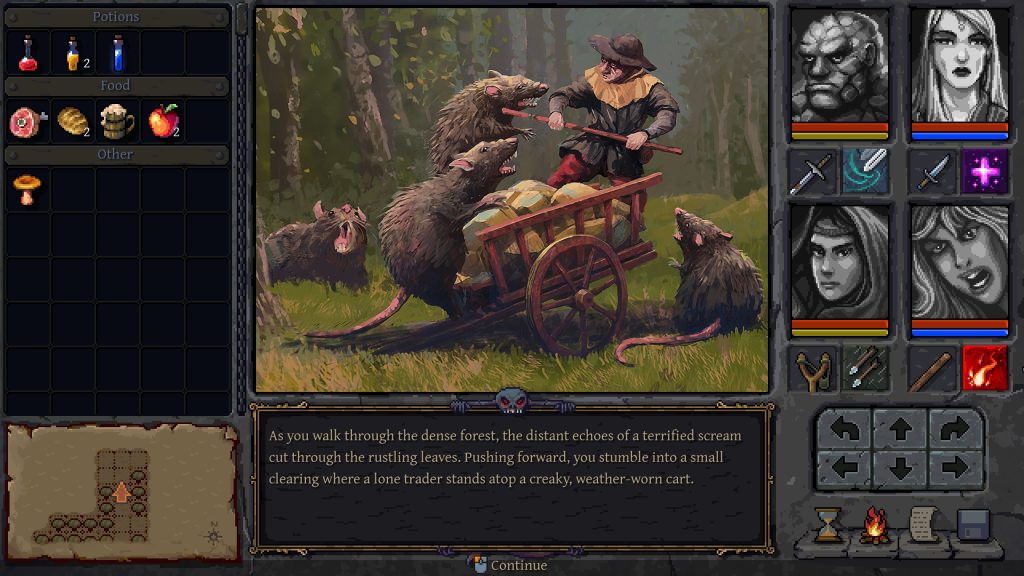
Resource management reinforces this structure. Mana and stamina serve as meaningful economic constraints throughout exploration. Every spell cast and every specialized action consumes finite reserves. Those resources cannot simply be replenished endlessly, forcing players to consider the long term consequences of short term decisions. Rest opportunities, consumables, and recovery mechanics become valuable strategic assets rather than afterthoughts.
The interface demonstrates a similar level of restraint. While firmly rooted in the visual traditions of classic blobbers, it includes enough modern conveniences to eliminate unnecessary friction. The automap system, enhanced through the use of custom markers, significantly reduces the burden of navigation without removing the importance of exploration. Players are still required to pay attention to environmental details, unusual architectural features, and hidden pathways. The game constantly rewards observation and spatial literacy.
This emphasis on navigation forms an important part of the experience. Exploration is not merely a method of reaching the next objective. It is a core mechanic in its own right. Progress comes from understanding the dungeon, uncovering secrets, mapping routes, and learning how the environment itself functions.
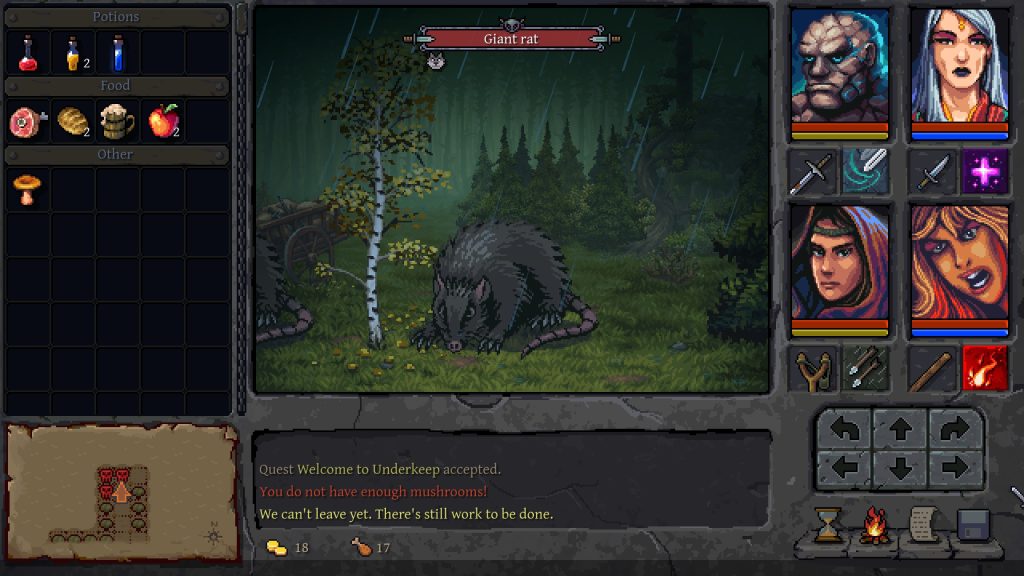
The larger question surrounding Underkeep concerns sustainability. Dungeon crawlers frequently face a difficult mid game challenge. Once players understand the core systems and discover effective solutions, maintaining engagement becomes considerably harder. If enemy encounters eventually devolve into larger health pools and inflated numbers without introducing new tactical problems, decision density can begin to collapse. Encounters become predictable. Exploration loses some of its tension. Systems that once felt deep risk becoming routine.
For this reason, the long term success of Underkeep will depend less upon its opening hours and more upon how effectively it evolves throughout the campaign. New enemy behaviors, class interactions, dungeon mechanics, puzzles, and environmental challenges must continue arriving to force adaptation. If the game can sustain that evolution, the framework appears capable of supporting a satisfying adventure.
Genre positioning also helps clarify what Underkeep is attempting to achieve. Comparisons to Legend of Grimrock are inevitable, yet the two games prioritize different forms of engagement. Grimrock’s real time combat relies heavily upon movement, positioning, and spatial manipulation. Players often succeed through mastery of battlefield maneuvering. Underkeep takes a different path. Combat is resolved through turn based systems that shift the emphasis away from execution and toward tactical planning.
As a result, it often feels spiritually closer to games such as Operencia: The Stolen Sun and classic dungeon crawlers like Wizardry. The emphasis remains on resource management, party development, exploration, and strategic decision making rather than physical dexterity.
This distinction brings us back to the tension at the heart of the review.
Personally, I find restricted movement and fixed perspectives frustrating. Free camera systems have become one of the genre’s most meaningful quality of life advancements, and I generally enjoy the additional immersion and environmental awareness they provide. There are moments during Underkeep where its intentionally old fashioned presentation reminds me of why the industry moved beyond these limitations in the first place.
Yet personal preference is not the same thing as criticism.
The developers set out to create a retro inspired dungeon crawler and they deliver exactly that. The restricted movement, grid based exploration, and deliberate pacing all contribute toward the atmosphere they are attempting to build. Judged against their own design goals, these systems are coherent and purposeful.
This is why Underkeep may ultimately appeal more to enthusiasts of the retro revival movement than to players seeking modern role playing experiences. Its value lies not in innovation but in refinement. Players attracted to this style of game are unlikely to judge it based on cinematic presentation or unrestricted exploration. They will care more about dungeon design, itemization, party management, lore discovery, resource economy, character progression, and the satisfaction that comes from gradually mastering a complex system.
Even the nature of combat reflects this philosophy. Boss encounters are less about quick reactions and more about preparation. Which assumes you have knowledge of the Boss. Which no one ever does because lets face it, today’s gamers are like bulls in a china shop.
(Also if you don’t already know most demos aren’t availible after they launch the EA)