



Newsletter Subscribe
Enter your email address below and subscribe to our newsletter

Rising Above the Noise
 Byocta
There is a quiet seduction embedded in the modern wishlist, a gesture so small and so frictionless that it feels almost ceremonial. You click a heart icon, you signal interest, and you move on. Yet this seemingly benign act carries a weight that most players never consider. A Wishlist is not a private note. It is a measurable declaration of desire, a data point that studios, publishers, and investors treat as a forecast of future revenue. It shapes budgets, influences production priorities, and distorts expectations long before a single system is functional. The paradox is simple. Players believe they are bookmarking a possibility, while the industry interprets it as a promise. The result is an ecosystem in which anticipation becomes currency and optimism becomes collateral, and the consumer becomes an unwitting participant in a cycle that rewards spectacle over substance.
Once you understand this dynamic, the surface of the industry begins to shift. The luminous trailers, the immaculate vertical slices, the choreographed reveals, and the aspirational language all begin to resemble a performance designed to secure your early faith rather than demonstrate real progress. Studios present visions rather than systems, atmospheres rather than mechanics, and aspirations rather than constraints. The consumer, conditioned to trust the spectacle, often discovers too late that the game they imagined was never the game being built. The distance between promise and product is not an accident. It is a structural feature of an industry that relies on early enthusiasm to justify late ambition.
The wishlist economy amplifies this distortion. A surge of wishlists can inflate a project’s perceived viability, embolden marketing departments, and pressure developers to expand scope beyond what their pipelines can sustain. It creates a feedback loop in which the illusion of demand becomes indistinguishable from actual demand, and the studio becomes trapped between the game they can build and the game the wishlist metrics imply they must deliver. The player, meanwhile, becomes emotionally invested in a product that exists primarily as a pitch deck. The disappointment that follows is not a failure of expectation. It is a failure of transparency.
This is why the modern player requires a new form of literacy, one that does not depend on technical expertise but on the ability to distinguish between performance and evidence. The industry leaves clues everywhere. They are visible to anyone who knows where to look, and they reveal far more truth than any cinematic trailer or influencer preview. The challenge is not access. The challenge is awareness. The casual player does not need to become an analyst. They simply need to recognize the difference between a promise and a product.
The purpose of this essay is to illuminate the structural forces that shape the wishlist economy and the hype cycles that follow. It is not an indictment of optimism. It is an indictment of opacity. The player deserves clarity. The player deserves honesty. The player deserves tools that protect their time, their money, and their expectations. And those tools exist. They are simple, accessible, and far more revealing than the industry would prefer.
Which brings us to the inevitable question, the one that emerges once you understand how the system functions and how easily anticipation can be weaponized against you. So how can you protect yourself?
That answer begins in the companion article below.
You protect yourself by learning to distinguish performance from evidence, and you can do it in five minutes. The industry thrives on confusion, on the blurred line between what is shown and what is built. Every trailer, every cinematic reveal, every influencer preview is a controlled hallucination designed to secure your faith before a single system is functional. The antidote is not cynicism. The antidote is literacy, the ability to read the surface and recognize the machinery beneath it.
The first principle of protection is visual skepticism. When you watch a trailer, ask what you are actually seeing. Are you witnessing a system in motion or a cinematic in disguise. Real gameplay is imperfect. It jitters, it stumbles, it reveals seams. Cinematics are immaculate because they are not interactive. The moment you see a camera that never shakes, a user interface that never flickers, or a character that moves like choreography rather than control, you are not watching a game. You are watching marketing. The difference is not aesthetic. The difference is structural.
The second principle is input verification. Search for off screen footage, developer livestreams, or hands on demos. Real input is unmistakable. The camera drifts, the player hesitates, the system reacts. These imperfections are the signature of authenticity. When they are absent, the footage is not gameplay. It is theater. The industry counts on your inability to tell the difference. Learn to see it.
The third principle is development transparency. Steam update history is the most honest ledger in gaming. It records every patch, every delay, every silence. A healthy project reveals itself through consistent technical updates, prototypes, and system notes. A struggling project hides behind lore drops, concept art, and community events. The update log is not marketing. It is evidence. Read it.
Together, these three principles form the Reality Check, a five minute audit that exposes whether a game exists or merely performs existence. It is not a comprehensive methodology. It is a survival instinct. The player who applies it will never again be blindsided by a cinematic that masquerades as gameplay or a wishlist that masquerades as progress.
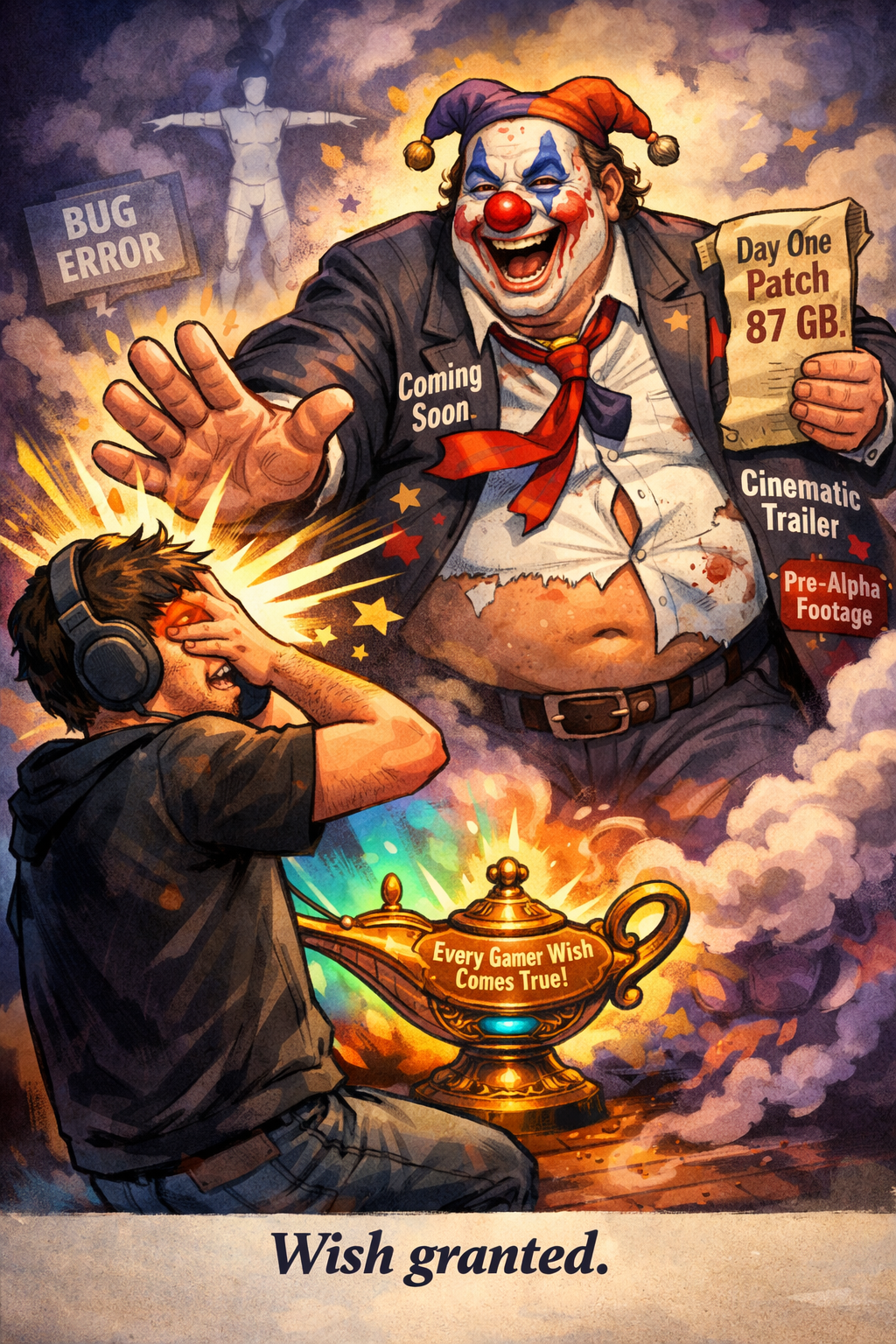
The illustration you just saw, the gamer rubbing the lamp, the corporate clown erupting, the slap, is not exaggeration. It is documentation. It is the moment every player experiences when hope collides with reality. The lamp promises that every gamer wish will come true. The clown delivers the truth that every wish has a cost. The slap is the lesson.
So the next time you feel the pull of the wishlist, pause. Rub the lamp if you must, but keep your guard up. The industry will always promise magic. The question is whether you have learned to see the smoke before it takes shape.
How many times have you rubbed the lamp and been slapped?