Rising Above the Noise
Byocta
The Roadmap Mirage: Skull and Bones and the Psychology of Manufactured Expectation
Share your love
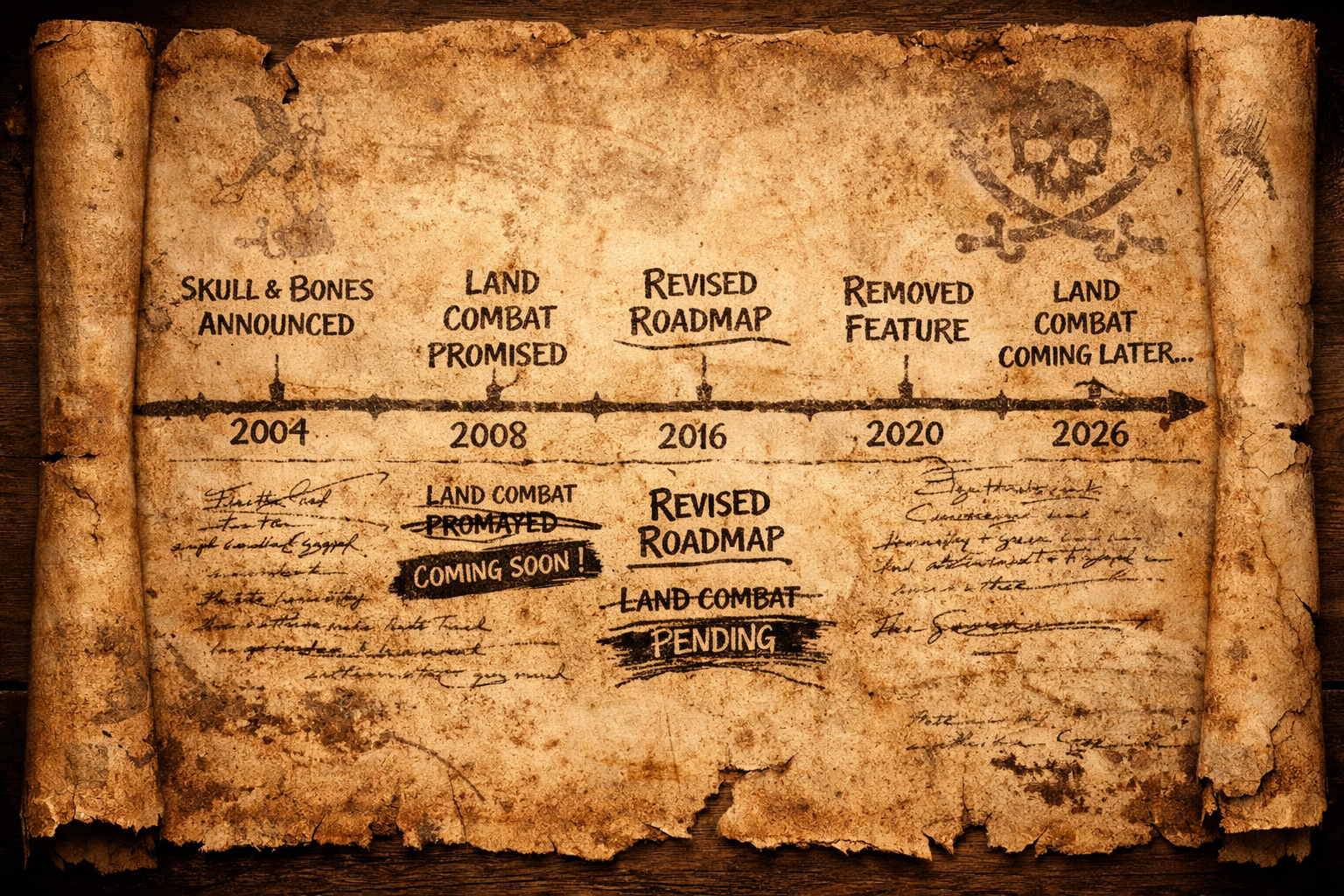
Skull and Bones has inadvertently become the most instructive demonstration of how contemporary studios manipulate the concept of the roadmap. The title entered the market with a conspicuous promise. Land combat would arrive in the second year of content and would serve as the architectural keystone of the game’s evolving identity. Ubisoft repeated this assurance across showcases, interviews, and promotional materials with a confidence that implied inevitability. The community accepted the delay because the roadmap presented the feature as a foregone conclusion. Then the seasons unfolded. The cadence decelerated. The rhetoric softened. The promise migrated from one season to the next before dissolving entirely into a quiet revision. The roadmap was not amended. It was erased.

This phenomenon is not an aberration. It is a structural pathology within the live service model. Studios routinely announce features that exist only as conceptual abstractions. Publishers encourage the premature revelation of content that has not yet survived internal scrutiny. Marketing departments treat the roadmap as a theatrical device rather than a developmental covenant. The result is a cycle in which ambitious declarations are made early, reinterpreted later, and abandoned entirely when the delivery becomes inconvenient.
The consequences extend far beyond the simple disappointment of a missing feature. Players do not interpret roadmaps as promotional material. They interpret them as binding commitments. When a studio publishes a roadmap, it invites the audience to imagine a future version of the game. Players begin to construct expectations, allocate time, and invest emotional energy into the projected evolution of the experience. This creates a psychological anchor. The promised future becomes the normative baseline. When the studio fails to deliver, the anchor collapses. The player experiences a form of cognitive dissonance. The imagined version of the game evaporates. The investment feels squandered. Trust erodes. Engagement diminishes. The player becomes more sceptical, more guarded, and less willing to commit to long term progression.
This is the essence of roadmap inflation. When studios announce more than they can realistically produce, they inflate the perceived value of the future. The roadmap becomes a speculative fiction rather than a developmental instrument. The more extravagant the promises, the more fragile the structure becomes. When the delivery falters, the entire edifice collapses. The psychological damage is cumulative. Players begin to assume that every roadmap is provisional. They treat every promise as conditional. They view the live service model as a temporary amusement rather than a sustained ecosystem.
Skull and Bones illustrate this erosion with unusual clarity. The absence of land combat did not merely remove a feature. It altered the conceptual identity of the game. The promise of on foot encounters implied a broader world, a richer sense of spatial presence, and a more ambitious design philosophy. When that promise collapsed, the game was forced to exist within a narrower conceptual frame. The world felt smaller. The systems felt more repetitive. The long term vision lost coherence. The roadmap had promised a metamorphosis that never arrived.
The industry has normalised this behaviour to a degree that borders on indifference. Roadmaps are published before the team possesses the capacity to fulfil them. Seasonal structures are announced before the content exists in any meaningful form. Features are teased before they have passed internal review. The roadmap becomes a catalogue of aspirations rather than a schedule of commitments. When the studio fails to deliver, the revision is treated as a minor administrative adjustment rather than a breach of trust. The players are expected to accept the alteration without protest.
This approach harms the developers as much as the audience. Teams are compelled to pursue public promises that were made without their consent. They are pressured to meet deadlines that were established for marketing optics rather than production realities. They are blamed when the roadmap collapses, even though the collapse was inevitable from the moment the promises were made. The cycle produces burnout, frustration, and a culture in which transparency is discouraged because honesty is perceived as a liability.
The solution is not complex. Studios must rediscover the value of restraint. A roadmap should reflect the actual state of development. It should be updated with candour rather than obfuscation. It should avoid speculative features that may never reach production. When a delay becomes necessary, the studio should communicate it directly rather than quietly rewriting the timeline. Players respond to honesty with patience. They respond to silence with suspicion.
Skull and Bones is not a failure of ambition. It is a failure of communication. It demonstrates how easily a roadmap can become a mirage and how rapidly trust evaporates when promises are treated as disposable. The industry must recognise that the roadmap is not a theatrical prop. It is a public commitment. When that commitment is broken, the damage extends far beyond a single feature.
Until studios treat the roadmap with the seriousness it demands, players will continue to interpret every promise as provisional and every season as a calculated gamble. The lesson is simple. Announce less. Deliver more. Replace speculation with clarity. Replace hype with honesty. Replace the illusion of progress with progress that can be observed, measured, and believed.